
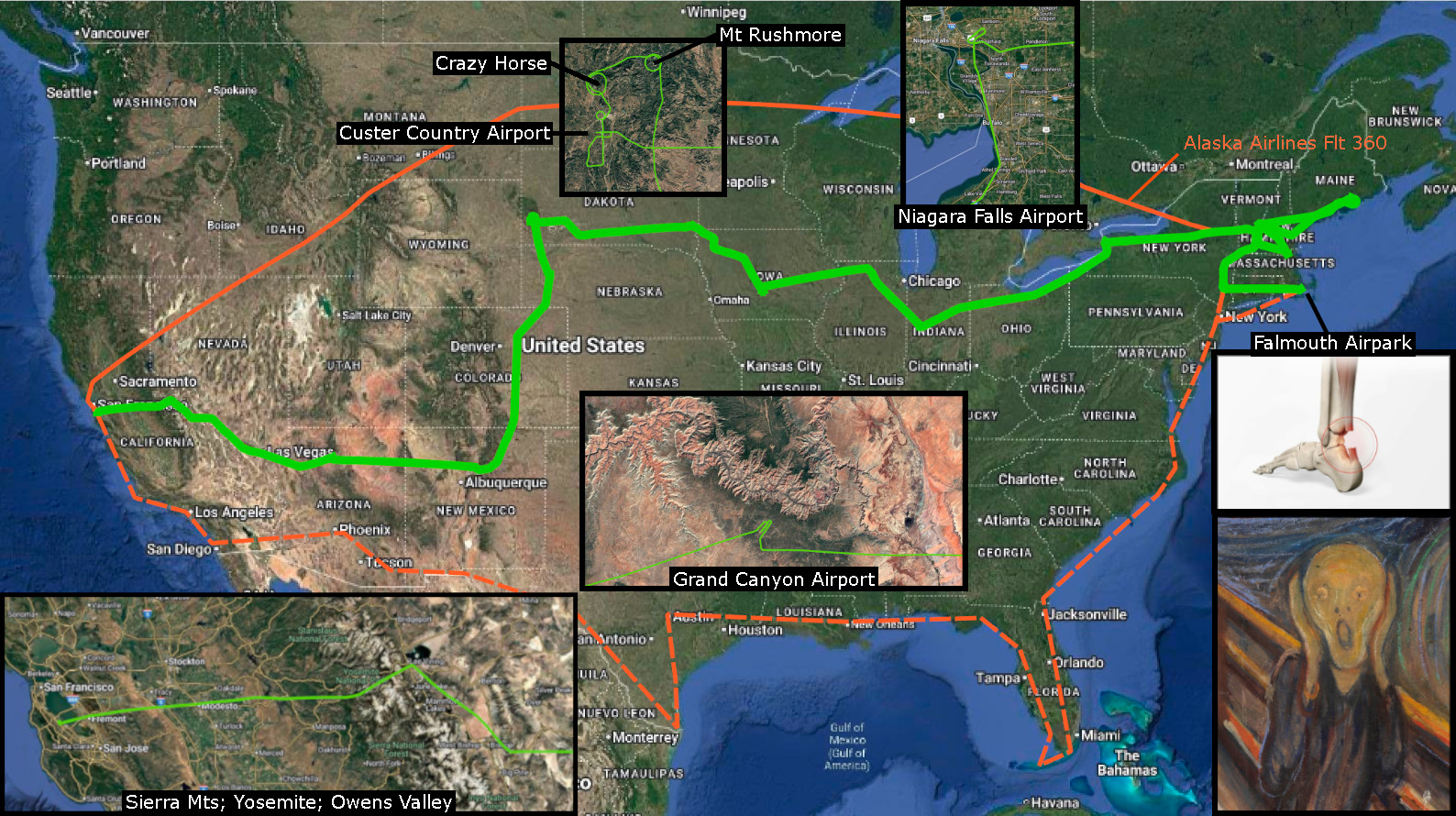
Four months after receiving his pilot’s license, SCFC member Bob Turcott embarked on a multi-week, around-the-country solo flight. In this presentation, Bob will cover topics such as reasons to consider making such a trip; suggestions for low-hour pilots to develop the necessary proficiency; useful gear; cool airports; his worst decisions; helpful attitudes; and a few life lessons that were encountered along the way.
Anyone who pushes heavy objects – such as planes – risks Achilles tendon rupture, especially if done in a thoughtless way. Unfortunately, this is what Bob experienced, 2,800 miles from home. Since the consequences of this injury are severe, even potentially career-limiting for pilots, Bob will review this clinical entity in detail. In the process, he’ll touch on useful general information, such as an approach to evaluating competing treatment options, as well as information that’s of particular interest to pilots: how to reduce the risk of tendon rupture while moving a plane.
About the speaker: Bob first soloed as a high school student in a used, 1970’s era hang glider he acquired through a classified ad. After a handful of flights, it became apparent even to him that self-teaching was probably not the wisest approach, so he set aside his glider and instead focused on ground school, eventually earning a PhD in Electrical Engineering/Signal Processing from Columbia and subsequently an MD from Stanford. He went on to become Board certified in Internal Medicine and Cardiology. In the process, he resumed hang gliding, but with modern equipment and formal instruction. His personal best was a four-hour flight with 3000’ altitude gain above launch in the foothills of the Sierras. Though no longer professionally engaged, Bob’s fond memories of his career include working with veterans as a general cardiologist, conceptualizing and implementing novel approaches to chronic implantable hemodynamic sensing, and contributing to the development of a diffuse optical tomographic system for the real-time detection and decoding of brain activity using a noninvasive, wearable device. Physical ability permitting, Bob hopes to obtain instrument, glider, and seaplane ratings, explore light aerobatics and backcountry flying, and complete the around-the-country trip he began in 2025.